
ACNA's Provincial Assembly debate on the Provincial Constitution & Canons Committee
Transcripts of an example-setting discussion

Yesterday, the ACNA’s Provincial Assembly met to ratify canonical amendments passed by the denomination’s Provincial Council last week. One item they ratified was the amendment creating the Provincial Constitution & Canons Committee, which I had opined on here. Since I opined, I wanted to also publish the subsequent debate on the item that occurred on the floor of Provincial Assembly. During debate, several delegates spoke about the proposal, which ultimately passed with 78% of the vote. (The other votes to ratify Title IV reform and archiepiscopal succession planning were ratified with margins of 97% and 99% respectively.)
In my opinion, the debate sets an example of the kind of scrutiny that rank-and-file delegates are capable of and responsible for bringing to legislative deliberation, so I commend it to your reading. You can also watch it here.
JULIAN DOBBS: So we come now to our first canonical resolution. And I’m going to call now upon the Reverend Doctor Mary Baker, member of the Governance Task Force, to give a report regarding the first canonical amendment that’s been presented to the Provincial Council for ratification. I want you to note that this amendment is on our Provincial Assembly document portal. You can find it there under the Resolution tab of this Zoom event. So I welcome Mary now to give her report.
MARY BAKER: It is my honor to present to you for ratification an amendment to Title I, Canon 4 of the ACNA canons. This amendment received a robust vote of approval by the Provincial Council in their June 2025 meeting.
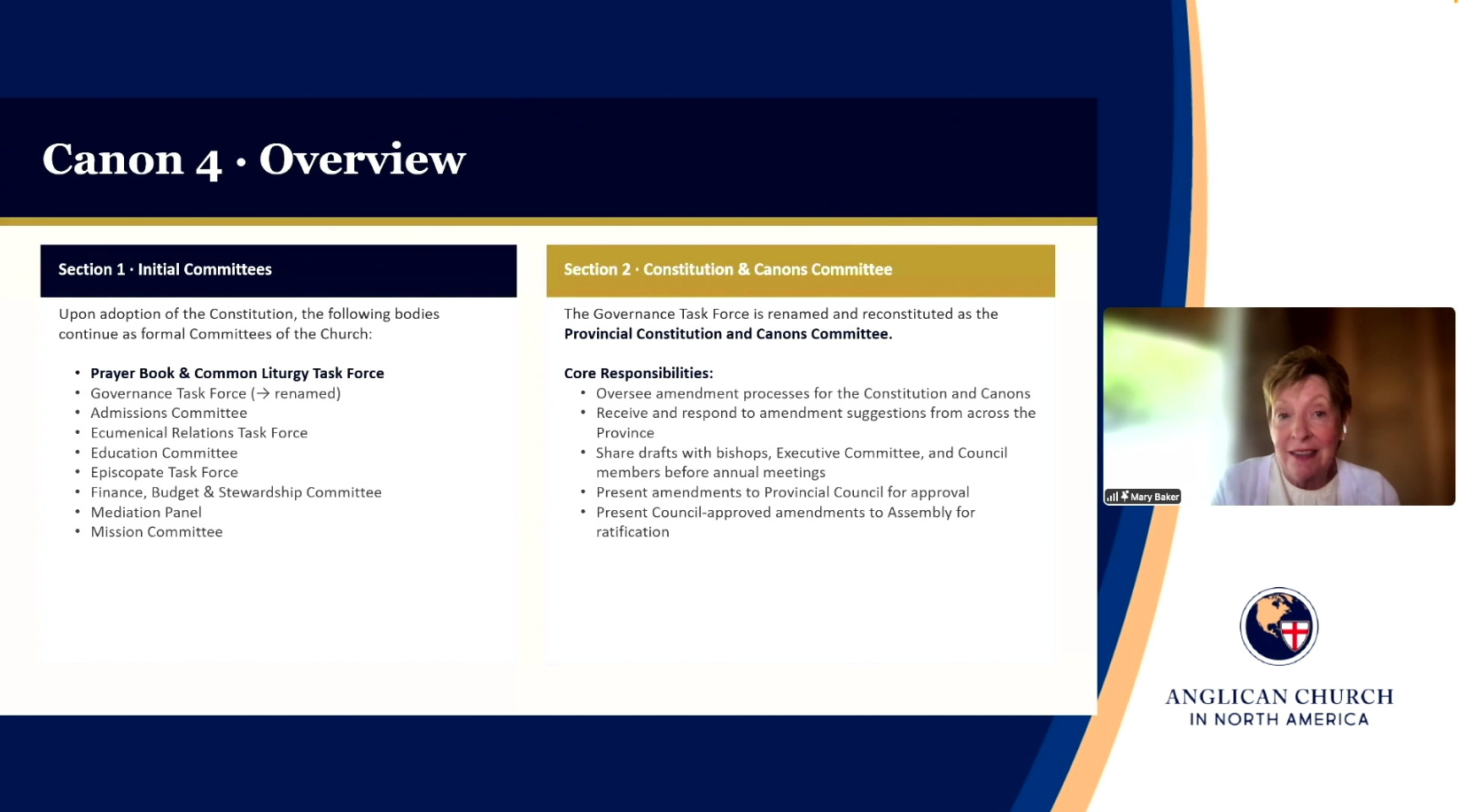
The purpose of this new canon is to create a canon that authorizes the process of how we change our canons. The present Title V canon, one of our canons, merely states that amendments must be ratified by a majority vote of the Provincial Council and Provincial Assembly, without any indication how these amendments are drafted for approval. Another provision of our canons, the current Title I Canon 4 which we are amending, specifies that the Governance Task Force is a committee of the province. As you can see, other task forces and committees are listed on this slide, but it does not authorize this committee to do the work of preparing amendments to to be brought to the floor of Provincial Council.
So this new canon will authorize the former GTF to be reconstituted as the Provincial Constitution and Canons Committee. To do that work, therefore, the canon will authorize the current practices of the GTF, a process of writing amendments that has developed over our life together as a province. Accordingly, before this canon was brought to the floor of the PC in 2025, it went through the same process that is being described here, a process that requested input and then extensive revision periods before it came to the floor to be voted upon to be overwhelmingly approved in 2025.
The second box on this slide, then, summarizes the responsibilities of the Provincial Constitution and Canons Committee. As you can see, the purpose of the committee is simply to aid delegates to the Provincial Council in their primary role as the chief principal legislative body of the province. In developing revisions, as you can read, this is a transparent process that will allow full and careful engagement in a revision process by not only delegates to Provincial Council, but to all members of the province. Through this process, members of the province and PC will be given the opportunity to carefully review and comment upon any proposed changes before they are brought to a vote at the annual meeting.
This kind of careful review cannot be done properly if legislation is only introduced and initiated from the floor of a provincial meeting and voted upon immediately, depriving delegates of the opportunity to carefully review the proposed canon and the impact it will have on our province. However, this canon does not remove the ability for any ten members of the Provincial Council to bring a resolution for canonical change before the PC at its annual meeting. In fact, such a resolution was brought to the floor of the Provincial Council last week and a full debate took place and the merits of the resolution before the vote was taken.
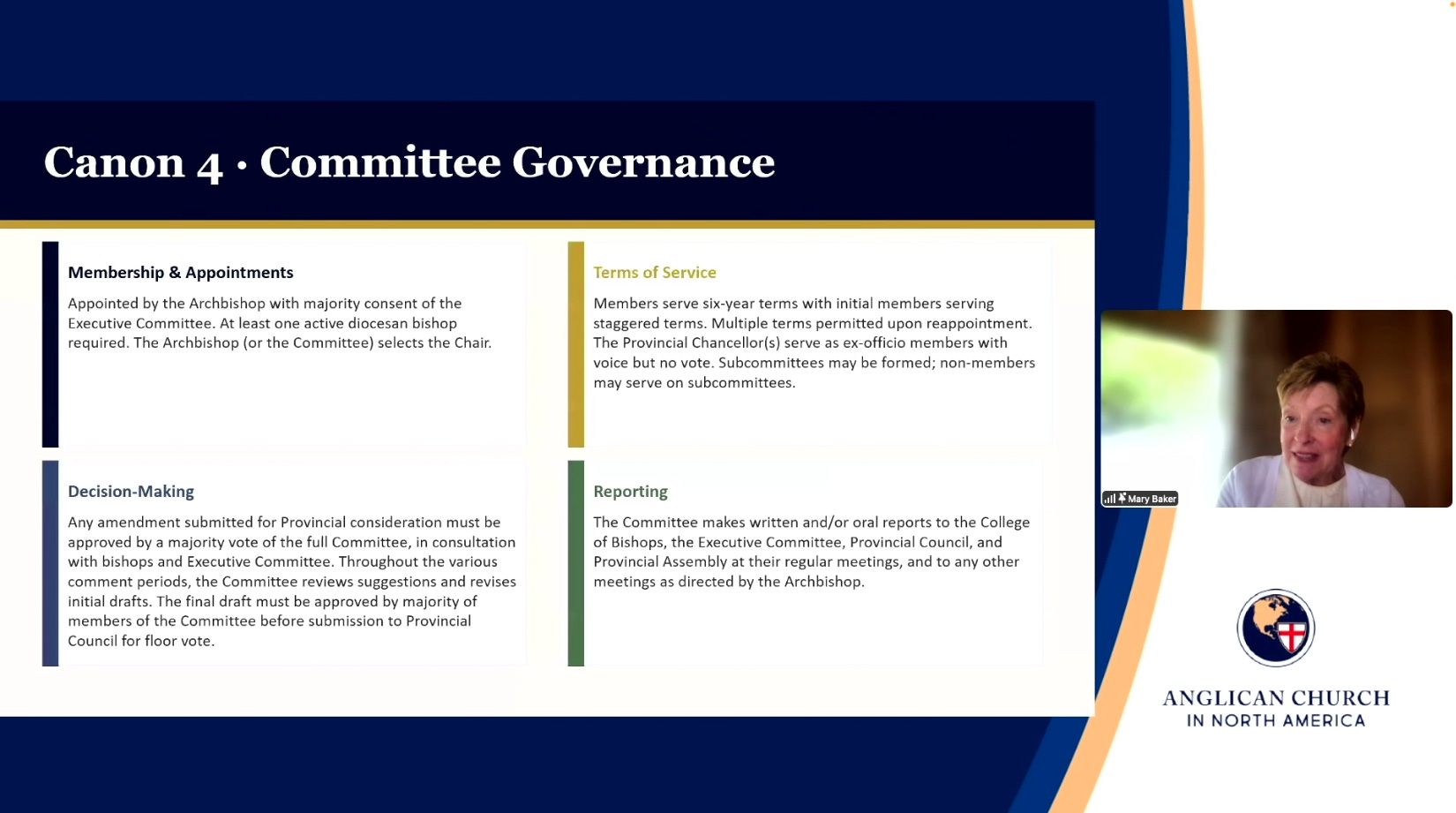
This next slide breaks down the contents of the canon’s membership and appointments. This new canon creates checks and balances between the office of the Archbishop and the Executive Committee. Members of that committee, of the Executive Committee, are voted and elected by Provincial Council. Thus, this committee represents the work of the Council. First, as far as appointments, it requires that members of the Committee will not only be appointed by the Archbishop as they are presently, but also approved by the Executive Committee. Additionally, no member of the committee can be removed by the Archbishop without approval by the Executive Committee. The Archbishop may appoint the chair, or the canon stipulates he may allow the Committee to elect their own chair.
“Terms of Service.” This box indicates the length of the service of the members of the Committee, and explains the role of the provincial chancellor, who serves as an advisor, not a voting member to the committee. The committee also is authorized to appoint subcommittees to undertake initial studies and possible initial drafting of the proposed changes, and then report back to the committee at large. Members of subcommittees can be chosen from members, any member of the province at large, especially those who may have a special expertise that will aid the committee in its deliberations. Such a committee worked on the first draft of Title IV for one year.
The “Decision-Making” box points to key decisions made by the committee, and the next slide will provide a graph describing this process. The final box, “Reporting,” summarizes another provision of this new canon: the opportunity for the committee to independently make reports to the College of Bishops, the Executive Council and the Provincial Council, and any other provincial meetings throughout the year.
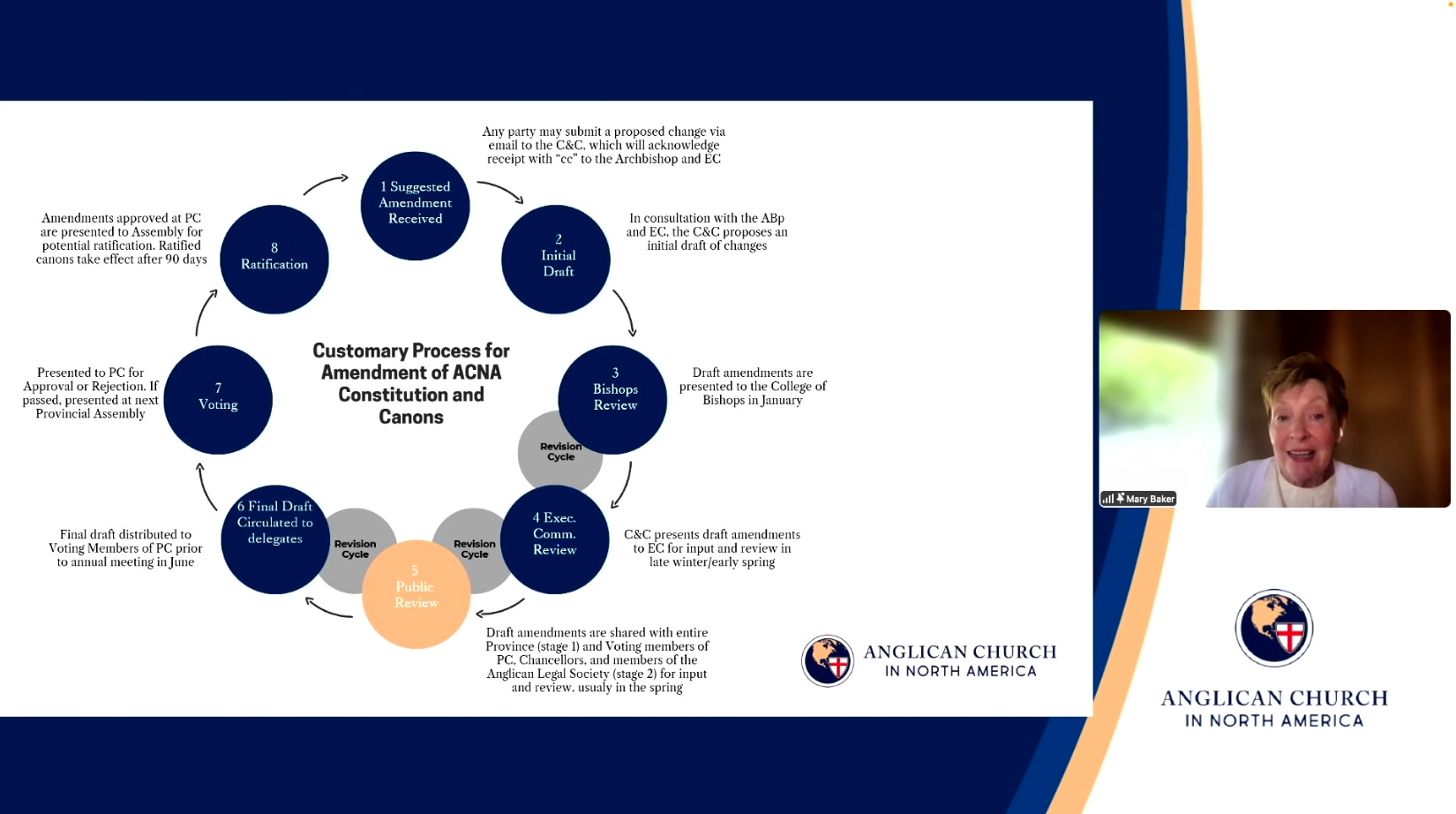
[INAUDIBLE] is a graph that illustrates [INAUDIBLE] the customary process. First, any member of the province may submit a suggested amendment. There will be a form on the provincial website which will be forwarded to the Archbishop, the Executive Committee and all members of the Provincial Constitution and Canons Committee. The committee will carefully review and consider each proposal, and will dialogue with the proposing parties as to the content of the proposed amendment and, after a vote of approval to undertake a drafting of this amendment, we will provide a timetable for the drafting.
The diagram then illustrates the four comment periods the Committee undertakes, after which revisions may be made in response to those comments in the public stage. Draft amendments are first shared with the entire province and then, in the second stage, to only voting members of the Provincial Council, chancellors and members of the Anglican Legal Society for input and review. After the revision periods, the final draft is sent to the delegates approximately three weeks before they meet and at Provincial Council will engage in a discussion on the floor before the amendment is presented for an up and down vote.
Thank you, Dean Dobbs, for the opportunity to summarize the content of this amendment to Title I, Canon 4 that will canonically authorize how an amendment to our constitutions and canons will be accomplished in an orderly and transparent process by a Provincial Constitution and Canons Committee.
DOBBS: Mary, thank you so much. Members of Provincial Assembly: amendments to the canons require approval by Provincial Council, by majority vote and ratification by majority vote of Provincial Assembly. This amendment has been approved by Provincial Council. Do I have a motion for the resolution that the amendments to Title I Canon 4, numbering the existing paragraph as Section 1 and adding a new Section 2, “Concerning the Provincial Constitution and Canons Committee,” adopted by Provincial Council in 2025, are hereby ratified by Provincial Assembly in 2026? And of course, the way you’re going to do this is to raise your hand. I see multiple hands, and I’d acknowledge the mover to be Bishop Phil Ashey. Is there someone who is prepared now to second the motion? Thank you. I acknowledge Sergio Diaz as the seconder of the motion. Those of you who have voted, if you would ensure that your hands are lowered, because now I’m going to call for any discussion before we vote on the motion. It’s been moved. It’s been seconded.
And just before we move to discussion, our Rules of Order say that in debate, members shall confine themselves strictly to the point in debate. No member shall speak more than twice in the same debate, in the same session, and I ask that before you speak a second time, you wait until everyone who has wished to speak for the first time to do so. So we’ll move now to debate, and I have some hands raised. I’ll begin with Bishop Chip Edgar.
CHIP EDGAR: Thank you, Bishop Dobbs. I am excited about the way that Title IV has progressed through, with a really robust period of commentary back and forth between anyone who was interested in the province and the Governance Task Force. I think that it produced for us not a perfect, but a very, very good revision to our current Title IV canons that have left us with a lot of conflict and confusion. And I raised my hand to suggest that this bill, this resolution ought to go through a similar process and that has not had the opportunity to do that yet.
The process as outlined by Doctor Baker, as she presented this, was not undertaken as we considered this. It came to the floor for Provincial Council last year. There has not been an invited period of feedback and conversation about this. So I actually would like to move that we table this resolution until the next scheduled Provincial Assembly, with the Governance Task Force providing a similar — perhaps not as extensive as Title IV received — but a similar process for feedback and contribution from the whole province. If we’re going to have a system of government that doesn’t permit amendment from the floor of either Provincial Council or Provincial Assembly, this kind of period is necessary and it hasn’t been provided yet. So my motion is to table until next regularly scheduled Provincial Assembly.
DOBBS: Thank you, Bishop Edgar. Bishop Edgar has called for the motion to be tabled for the next Provincial Assembly, which has not yet been set. I would ask those of you who have your hands raised for discussion on the original resolution to lower those. I will now call to see if there is someone who will second the motion by Bishop Edgar, if you would raise your hands. Thank you. I see some hands raised. I will choose Hamilton Smith as the seconder at the moment. We’ll pause just for a moment for my ability to consult with the parliamentarian, so there will be a brief period of silence.
So this is not a debatable motion. If those of you who have, hands raised, would you lower them? We’re going to vote by raising hands. If you’re supportive of this motion to be tabled to the next Provincial Assembly, if you would please raise your hands electronically now.
ANDREW ROWELL: Bishop Dobbs, may I say something about Bishop Edgar’s comments about its lack of review before we vote on the tabling motion?
DOBBS: I have called for the vote, but, I’m happy for you to speak.
ROWELL: Is this a good time for me to speak?
DOBBS: It is.
ROWELL: Well, this is Andrew Rowell, I’m the chair of the Governance Task Force. And, with all due respect to Bishop Edgar’s comment, this particular amendment went through the normal wheel of review that Doctor Deacon Baker reviewed. It went before the College of Bishops, before the EC, out to the entire province for comment and review. There was robust conversation. We sent multiple memos out to the whole province before we brought it to the floor. And so I would dispute the idea that we treated this any differently than we treated Title IV. Now, Title IV, because it was 56 pages long, did go through several years of review within committee, but it went through a yearlong review process as did this amendment. So I would counsel a vote against this movement to table because this was a legitimately reviewed, affirmatively voted — there was no opposition to this at Provincial Council 2025. And I think it is appropriately ratified today.
DOBBS: Okay. Thank you, Canon, and I’ll ask for the vote to continue. This vote will be by electronic hands. If you’re voting, what you’re voting for here, to be sure, is that this resolution be tabled until the next called Provincial Assembly of the Anglican Church in North America. So if you’re in favor of that vote, I’m going to give a few more minutes for you to raise your hands. Few more moments. I will ask that voting be closed in 10 seconds. I now declare voting to be closed in favor of the resolution to table. If you would all lower your hands, please, if you have them raised. I will now call for those who are voting against the tabling of this resolution to raise their hands. You go down to the reactions tab. You press the tab that says Raise Hand, and our stewards are going to record the votes. If you’re voting now, you are voting that the resolution to table from Bishop Edgar are that you’re voting against that resolution. You haven’t cast your votes yet. I invite you to do so. I will declare that voting be closed in 10 seconds. I now rule that voting is closed on the motion to table, and I shall await communication from Mr. Hassler on the vote.
DAN HASSLER: Bishop Dobbs, I would report that the motion failed.
DOBBS: Thank you sir. So I record that the motion does not pass. We return now to debate on the motion presented to us in the name of Bishop Ashey, as presented by Reverend Baker. And I welcome further discussion. So if you have discussion on this motion, please raise your hand. If you still have your hand raised, with regards to your vote against the tabling of the motion, please remove that so I know who is going to speak. So if you have discussion on this motion, would you please raise your hand? And I acknowledge Canon Bryan Biba, Canon Bryan Biba from Gulf Atlantic Diocese.
BRYAN BIBA: I have a clarification question on the new Section 2, Subsection 5. If I read this correctly, at least one member of the new Constitution and Canons Committee shall be a currently active diocesan bishop, which means that technically, by canon, there is only one serving delegate of Provincial Council on this committee. And if this committee is indeed to serve Provincial Council, it makes sense to me that there would be mandates for both clergy and lay representation on this committee. That way it would foster more deliberation in addition to consultation. Just to say also that while the wheel of revision is really helpful, that is a process of consultation. It is not a process of deliberation; that can only happen in person. And I would ask that the Constitution and Canons Committee, a), explain why clergy delegates of Provincial Council will not explicitly included by canon. And second, I would ask them to consider potentially opening up open working sessions to invite all Provincial Council delegates to participate in their working meetings in order to foster greater deliberation. Thanks.
DOBBS: Thank you, Canon Biba, good to see you, sir. Thank you for your faithful ministry. I’ll invite Canon Rowell to respond if he wishes to do so.
ROWELL: I’d be delighted. Thank you, Canon Bryan. Indeed, to your second point, you and I discussed at Provincial Council the building in of some periods at Council, pre-meeting, where we could have further robust conversation about the language that’s been presented. And I think it’s a great way forward, and we should talk more about that. On the matter of, kind of, canonically mandating who shall serve on it, I would commend further work on the language of this canon. No one raised that in the yearlong review process. This is the first I’ve heard of in addition to the one diocesan, be real specific about clergy-lay balance. I think it’s a fruitful conversation and it’s one of the reasons why, whenever we vote something up or down, we know that we’re placing it in the canons, but then it’s always subject to further iterative change. So I look forward to working with you on some language about that. The reason we have one diocesan bishop is because it’s hard to get a diocesan to serve because they’re busy. But we always need their perspective about how these canons are going to land in a diocesan setting. It’s no less true that we need priests and deacons and laypeople as well. And we have that currently, but it’d be helpful to have it canonized. So I’m in agreement with both of your comments.
DOBBS: Thank you sir. I recognize Paige Forster, if you’d like to address the Assembly.
PAIGE FORSTER: Good afternoon, Paige Forster from the Diocese of Pittsburgh. And my comment on the resolution as it stands is that the members of the PCCC are not required to be members of Provincial Council, which, to me, is an odd situation. It’s akin to a situation where a legislative body, like the United States Congress, doesn’t propose its own legislation, but rather a body of people who are not members of Congress necessarily would propose legislation. So, a legislative body that doesn’t propose its own legislation is greatly reduced in its role as a legislative body, and I’d be interested to hear any response about it. But it is a concern that I have after study and review. Thank you.
DOBBS: Thank you so much. Canon Rowell.
ROWELL: It’s a great question, Paige. I do appreciate it. I do think that, one thing to remember about the top of the wheel that Deacon Baker presented is that we can take input from the entire province. I mean, one of the principles of canon law is that what touches all should be decided by all. And the Provincial Council is the chief governing body of the of the province, and so anyone who is a member can present proposed legislative change; but only the Council can deliberate that change and vote on that change. And so I would say that we could limit the — you can only propose canonical changes if you are an elected member of Provincial Council. But instead, what we’ve said is: anyone can propose changes, but those changes will be filtered through a transparent and visible process so that when it gets to Council, it’s been considered for, you know, six months, eight months, nine months, depending on when that first draft goes out to the province. And then again, as Deacon Baker pointed out so well, Provincial Council can of its own accord bring an amendment or bring an agenda item to make legislative changes from the floor. Nothing’s preventing that. This is just kind of taking that debate and stretching it out over roughly a year so that we can make wise changes and not impulsive ones. So I don’t know if that’s an adequate answer, but it’s the thinking behind the wheel.
DOBBS: Thank you, Canon. I recognize Doctor Walz.
JERALD WALZ: Thank you, Bishop Dobbs. Point of inquiry directed at the speaker. Does this legislation, this resolution, allow the PC3, the Provincial Constitution and Canons Committee, to turn down a proposed resolution that goes to the committee?
DOBBS: Canon Rowell.
ROWELL: Essentially, yes. I mean, we do get amendments presented sometimes that are shared with the Archbishop and with the Executive Committee. You know, we’ve had motions that [INAUDIBLE] or ask us to change the canons to eliminate women’s ordination. And, you know, we realize that that’s a proposal for a canonical change that’s in direct conflict with our constitution. And we try to deal with such proposals transparently, but there are things that don’t move forward.
I would say this, though, is that anything that does — that, you know, dies in committee if you will, still is an active intellectual matter that could be brought by ten members of Provincial Council by bringing, just like Elijah Lovejoy and Matt Wilcoxen did at Provincial Council. I think it’s a great example of this being one way of bringing amendments to the canons to the floor. But there are other legislative muscles that we can flex, and we’ve just recently flexed. And so I think we’re learning how to do this. But yes, it is true that some things don’t ever come out because they’re simply not consonant with the rest of our canons and constitution.
DOBBS: Thank you, Canon. I acknowledge Amanda Rosengren.
AMANDA ROSENGREN: Hi, Amanda Rosengren from Diocese of Churches for the Sake of Others. My concern with this amendment has to do with the ways in which the members of the committee will be selected: appointed rather than elected by the Provincial Council. I understand the need for it. However, it is my opinion that that takes the power of governance again further away from the Provincial Council, which is given that authority in our constitution and canons. I understand that Executive Committee can — is to approve it. Again, it seems to me that it gets it backwards from the way that I would like to see it be. That’s my concern.
DOBBS: Thank you, Ms. Rosengren. Canon Rowell.
ROWELL: Well, at Provincial Council 2025, Amanda — I do recognize the concern and what all I would say is what I said at Council 25, which was that the work of the Governance Task Force is specialized. It extends over many years. I mean, I’ve, you know, the work of what we just did was a three-year grinding process to get Title IV ready for, you know, a public sharing and comment, and it requires a lot of flexibility, both on the number of people that serve on the committee and their various areas of expertise. Things bubble up sometimes that we need to bring people into subcommittees. So I’m not disagreeing, but the decision has been consistently over the last, you know, fifteen, seventeen years that we’ve been in existence, that we would allow the archbishop to appoint these folks. And this is — this amendment does curtail the authority of the archbishop to appoint by making the advice and consent of the Executive Committee a part of both appointment and removal. So we’ve tried to bring in more conciliarism into that appointment process, but it was our position that appointment made more sense than election. I don’t know if that’s satisfying, but that’s where we were.
ROSENGREN: Thank you. I still disagree, but thank you, Andrew.
DOBBS: I’d like to invite Doctor Baker to speak if she wishes to do so.
BAKER: Yes. Thank you. I think these all are excellent ideas. I’m a member of the Governance Task Force. I believe that we may want to consider at least making a portion of the committee to be elected by the Provincial Council, or that they only can be Provincial Council members. However, there is a certain expertise that is needed. We have on the committee experts in canon law. And I would hate to see the committee be limited to only the members of the Provincial Council to do this work.
Also, I want to speak to the other question about turning down, and Canon Rowell, you can correct me if I’m wrong, but I’ve been on the Governance Task Force for eleven years, and I can only remember twice — two proposals that we did not — that we did need to go and consult with the House of — the College of Bishops and the Executive Council [sic] on. One was the vote as far as women’s ordination, and the other concerned enlarging the power of the Special Jurisdiction. And these were suggestions, as Andrew said, that went directly against our current canons. So that would be the only instance, I believe. I don’t think there needs to be this worry that we are gatekeepers.
And this canon is not perfect. I’m sorry we didn’t get more of these comments when we were deliberating on it, when we started deliberating on this and presenting it out for comment in the fall of 2024. But, if we do not accept this amendment today, we still are in a position that we have no official committee authorized to do the work. And that can, I think, believe — I believe that could possibly create more chaos than some of the things that are being brought up today. Thank you.
DOBBS: Thank you so much, Mary. I want to remind delegates to Provincial Assembly that if you wish to speak, please raise your hand electronically. To do that, you need to look for the react tab at the bottom of the screen on the toolbar, and you’ll see a button there that says Raise Hand. If you click on that button, I will see that you wish to speak, and a reminder that you’ll have two minutes to speak and you must speak, pertaining to the motion, the resolution that I have presented to you. So I acknowledge now Canon Seth Cain.
SETH CAIN: Good evening. Thanks, Bishop Dobbs. I just, first of all, want to say that I am in support of something like the PCCC. I think that we — my suggestion probably is consistent with what Canon Rowell is saying, that, you know, changes can be made, et cetera, et cetera. And I was in agreement with Bishop Edgar in tabling this, because there is some language that seems problematic, not least of which is the word “may.” And to Canon Rowell’s point, we’re looking for transparency. We’re looking for, I think, interaction between all the bodies that would be involved in our legislative process. But one of the things that could be debated, considered as with more time, is what the language of what this PCCC “may” do. And that’s in, if I recall, it’s in Section 2 there, number 3 — all — it seems to me that a)-e) are all options for them, as opposed to things that they would actively be doing procedurally as they are deciding upon, deliberating, and handling these matters. So I’d love to hear Canon Rowell speak to this, that particular language again; the questions that that raises, I think, are the very reasons why we, some of us, are calling for additional deliberation and tabling this going forward. As Ms. Baker said, it’s imperfect. And I think some of the ways in which this is imperfect are pretty glaring. So that that would be my point. And so my question to Canon Rowell.
DOBBS: Thank you so much. I’m going to ask Canon Rowell to pause in his answer. I’m going to go to Mr. Haberman first, and I’ll get you to address both matters at once, Canon Rowell. Mr. Haberman, we need you to unmute, sir.
KIRK HABERMAN: Thank you so much for your kind reminder. My name is Kirk Haberman. I am a lay delegate from Pittsburgh. A very thoughtful parishioner in our diocese, two days ago sent me a concern. This was kind of off my radar, so I’m, actually, I’m fulfilling the role of delegate; I’m representing my diocese in sharing this concern. But it was, I think, an intriguing and subtle criticism. And I’m — it feels like others are kind of perceiving this as well.
He was suggesting that an unintended consequence of the creation of this committee could be undermining the Provincial Council’s — and this is my words, not his; I’m summarizing his argument — the PC’s constitutional role as governing body. That if most of what the PC ends up doing is kind of binary up-or-down approval, then it’s not actually doing the work of governance. And I think the recent example which was held up, of the kind of — the ten members, with — I think that was within the last week, proposing something from the Provincial Council; I think that actually wasn’t, the way that played out, to me, a great argument for the PC remaining governing body, because I think there was a — the way that played out, I don’t know — let me — I don’t want to use up my time on that.
He had an important question and that is: what safeguards exist against committee capture? So, during the review process and before the PC meets in person, can the PC or Executive Committee override it, direct it? Does the PC have any recourse for the removal or censure of the committee’s members? I think our concern is that the trajectory of this not undermine the PC’s role as the governing body, as the legislating body where the hard work of legislating is done. Thank you.
DOBBS: Thank you sir. Canon Rowell, on both those matters.
ROWELL: Yes. I’m happy to address both of them. First to the, why “may” and not the word “shall”? And it’s a great question. And it was heartily debated within both the GTF and in our public conversation with the whole province, which is that — we will do these things. I mean, the wheel that we showed you is the process that we followed for the entirety of our life together as as the ACNA. But sometimes we don’t get invited to the College of Bishops because they go into executive session and they close the doors. They’re in conclave. Sometimes the Executive Committee has an urgent matter in January, and our normal time of presenting proposed canonical changes at that stage doesn’t happen. And we wouldn’t, we didn’t want — sometimes we want a six week review period, and we wind up, because of the pressures of the moment, having a three week comment period. So we didn’t want to use the word “shall” and find a valid, positive canonical change thwarted because of one step in the process not happening because of situations beyond our control. If we don’t do one of those steps, it will happen in the light, because everyone will know it. I mean, the wheel that we showed you is now in the canon. And so our hope is that part of what you’ll see is us doing what we’ve promised to do.
And then this also goes to the concerns raised by the parishioner in Pittsburgh, which is, is there, you know, capture by the committee? If the committee is captured, then you’ll see it happening in real time. And Council, who is the only body that can approve, just as the body we’re talking to today is the only body that can ratify the Council, as the committee will have no authority to pass legislation, it will only be to propose it, to ask for comment, to look at, to consider, comment and review, and then to present it so that it can be voted on. You know, I think that we’re trying to work in transparency, so that the worst possible motives are not presumed. When we get to Council floor, the meaning of it and the reasoning behind it will have been transparently evaluated, and then it can be voted up or voted down. And that’s our hope.
DOBBS: Thank you, Canon Rowell. I acknowledge Dean Kaiser.
MARCUS KAISER: Thank you, Bishop. Marcus Kaiser. I’m a clergy delegate from the Gulf Atlantic Diocese. I hear I think many of us are getting at the same concern, and I’ve had a general concern that we might be a little overmuch, over-concerned about seeing Provincial Council bogged down into a debating body like some of us left, where we concern ourselves with, you know, banana tree slugs in the Amazon instead of the work of Jesus Christ on earth. That said, if we reduce that body too much to not debating, that’s a concern. Having served on the Liturgy Task Force, I just want to speak to the fact that it does raise resentment.
Deacon Mary mentioned there’s only been a couple of de novo proposals. It’s not the de novo proposals that I think we’re concerned about, but the fact that there have been suggested amendments to proposed canons that the committee itself says, “we don’t think that’s a good amendment.” So they squash it there. It’s a high bar to get ten members of Provincial Council to then override the committee. So I think we have a concern with that sort of openness. And I get it, there’s a balance to be struck here, and we have to be sure that we are addressing those things directly and openly. And I think the proposal may concern us too much with not allowing Provincial Council to do the work it wants to do and needs to do.
DOBBS: Thank you sir. I acknowledge Bishop Phil Ashey.
PHIL ASHEY: Thank you, your grace. Phil Ashey, bishop ordinary, Diocese of Western Anglicans, and former chair of the Governance Task Force. Much of what we’ve talked about today is a more conciliar approach to legislation than we’ve seen before. I would point out that the Wilcoxen-Lovejoy amendment actually did get the ten votes. It was not that difficult to get those ten people to sign up. There was good, robust discussion, and that is a step forward in our legislative process because now the legislative process actually begins in Provincial Council, where these amendments can be raised from the floor.
Secondly, the reason we don’t do wordsmithing from the floor is because of a great bishop, Jim Stanton, of the Diocese of Dallas, who once did a study of the costs of each resolution that was done on the floor of the Episcopal Church in its wordsmithing processes from the floor, and found out that there is a cost of $30,000 for every resolution of those how many that were largely irrelevant. Wordsmithing from the floor is not as effective as when it’s done in a committee with other people, who can also see the unintended consequences of choosing certain language. That’s why we have the process that we have.
I think this is a move in a positive direction. I simply note that in the same way that we have a note from Provincial Council that bishops can provide the respondent advocate that is much needed, while the Governance Task Force works on enacting that amendment to new Title IV, is a perfect example of how we can get more people involved from Provincial Council in the process, as well as some of Canon Biba’s comments. So I would simply point out that the engagement that we do in governance is moving in the right direction, and instead of doing it from the floor, we’re doing it in these processes that are outlined in the diagram that are very robust and can always be made even more robust. Thank you.
DOBBS: Thank you, Bishop. I’m going to come to you, Mr. Sorensen, in a moment. Members of Provincial Assembly, I want you to consider where we’re at in this debate. If you have new items to raise on this particular resolution, I’d ask you to consider those. If you are thinking that your matters have been addressed by previous speakers, I would ask you to consider whether it is necessary for you to speak so that I can keep the agenda to our time allotted. Mr. Sorensen, sir.
CHRISTOPHER SORENSEN: I just wanted to sort of say that, I guess this time everybody is is raising objections, and that’s appropriate. For what it’s worth, I think this seems great. It seems not that hard out of three hundred people for me to find ten people that will just, you know, counter, you know, whatever, make a proposal that’s counter to the Task Force or whatever. So, this seems reasonable. It’s good to have experts working on these things. This is not like Congress. None of us do this work, this particular work, full time. And so I like the idea that there are people out there working hard, trying to improve our governance, and knowing that there is the checks and balances of Provincial Council to propose other amendments or to push back on amendments. I feel like there’s checks and balances. That’s that’s my thought. Yeah.
DOBBS: Thank you, sir. Members of Provincial Assembly, I’m soon going to move to the question if there is no further debate or discussion. Mr. Lovejoy.
ELIJAH LOVEJOY: Just a point of clarification. So, is it true to say that there’s only two ways an amendment to the canons can come to the floor: either directly through the GTF or the PCCC, or through ten delegates? In other words, it’s either an end-run around the GTF, so to speak, or going through the GTF? It’s been stated that no amendments are allowed, and I think we’re challenging that notion. We’re saying an amendment has been allowed. But I just want to clarify, is there any other procedure through which an amendment can come to the floor?
DOBBS: Not to the floor of this Assembly, but certainly through the floor of Provincial Council — Canon, would you speak to that, please?
ROWELL: I would, I’d give — a good example is that Provincial Council, I think it was 2024. We had an amendment come from the College of Bishops. And I want to just note that the College of Bishops could not amend the canons. They did not have the authority to do that, but they were able to bring to the floor a proposed amendment that was affirmatively voted up by Council and then ratified by a later Assembly. So we’ve got evidence of a number of moments of real legislative activity by Provincial Council. And I just want to reiterate, too, that everything that — I’m calling it “the PC3,” because “the PCCC” sounds like the opposite of the Soviet Union, so we’re calling it the PC3 — the — what we do is simply trying to get the debate into a cycle where we can really consider language effect, consequences of language. And so when we come to Council, Council has weighed in on it already and then can vote on it. We’ve got — but you have other examples of legislative muscle flexing, if you will, within PC, but it’s — I don’t think it’s as effective as something that tries to do it in a very deliberate, considered way. And I will say too, that even though we don’t allow wordsmithing, we do allow deliberation; there is debate; there are comments. And I think this is a good example of this. And we’ve had a robust conversation about this canon today. I think that if you vote for it or against it, you’ll — it will be a considered vote.
DOBBS: So thank you, Canon. So yes, Mr. Carlson, and then Bishop Ashey, and then I’m going to ask for any final comments before we move to the question.
ETHAN CARLSON: Thank you, Mr. Dobbs. Ethan Carlson from the Diocese of Pittsburgh. I’m — just a question or point of clarification, for somebody who has great, like, thanks and appreciation for the move forward in this motion and all the work that’s gone behind it, but then also some hesitancy. And so for somebody like myself who may vote against, a question of — with all that in mind for the sake of the greater body, like — how large this group is, and would it be possible to have some explanation of, if this motion does not pass, of what then happens next? Because I think for many, there is a perhaps chance of voting against, although so grateful for 95% and not wanting to diminish that or to start over. Thank you.
DOBBS: I think Doctor Baker addressed that matter in her presentation, but I’ll go to either Doctor Baker or Canon Rowell to answer your question. And then I’m going to — before I call upon Bishop Ashey and Doctor Walz, they would be speaking for a second time, so I want to be sure that nobody else has something to say about this matter before I call on those two to speak. Canon Rowell?
ROWELL: Mary, I see you unmuting. Do you want to take that one?
BAKER: I just want to add that we would go back to the drawing board and we would consider amendments if — either way, either way, if it passes or it doesn’t; if it passes and we at least get an authorized committee doing the work that needs to be done, I think there does need to be an element of trust here in the processes, but we will entertain all of these ideas as amendments to this canon if it’s passed. Yeah. So if it’s not passed, we will have to go back to the drawing board. But yes.
ROWELL: And let me just urge you all to vote yes for this, because the Governance Task Force has been doing this process faithfully for the entirety of the life of the province. The creation of this canon was simply an effort on the part of the GTF to make the process more transparent, more obvious to everyone engaged in this process, and to check the authority of the sitting archbishop to be the sole arbiter of who sits on this committee. So all of the effort here is an effort to be transparent and have good checks and balances. I would urge all to vote for it.
If we vote against it, the Governance Task Force is still one of the foundational committees of the province. We will still be doing the wheel. We will just be doing it in a way that — it would be just as transparent, because we’ve talked about it all now, but it still isn’t something that you can fix along the way. So I think if you’re — if you think this canon is inadequate, I still encourage you to vote for it and then immediately start saying, “hey, could we tweak it this way? Could we adjust it this way?” Because we’ll continue this conversation into the future and that the Lord has for us.
DOBBS: Thank you, Canon. And I’m acknowledging some people who wish to speak for the first time, and I acknowledge Archbishop Beach.
FOLEY BEACH: I may be out of order, but I’d like to call the question.
DOBBS: Thank you, sir. Just a moment. I’m in consultation with the parliamentarian. With advice from the parliamentarian, you’re not out of order, but I would require a seconder to call the question. And if you’re wishing to second, please raise your hand. I acknowledge multiple people. Let me just see you for a moment. Thank you. I will acknowledge Tobias Karlowicz. Thank you. The question has been called. Would you please lower your hands, if they are raised. You will see shortly on the screen a Zoom poll on your screen. And —
WALZ: Point of order.
DOBBS: If you now go to the poll — someone’s calling a point of order. Yes.
WALZ: Bishop, a call for the question requires a vote by the Assembly before debate is ended.
DOBBS: Thank you. I regret that I did not call for the vote. So, let’s just pause there. Thank you very much. We’ll go to the vote. And I do believe that we’ll be able to bring that vote up as an electronic vote. So if you would just pause for a moment and we’d be voting on calling the question. Thank you so much for the point of order.
So if you just stand by for a moment, you’ll see a vote come up on the screen. we’re not going to be able to make that on the screen. So the way to vote now, on the motion that the question has been called is to vote electronically, go down to the reactions tab. If you’re voting in favor that the question be called, would you please electronically raise your hand? Now remember you go down to the reactions tab and you press Raise Hand. So if you’re voting in favor to call the question, I will close voting in just a few moments. I’ll close voting in 10 seconds. Voting in favor is closed. If you’re voting against the calling of the question, would you please raise your hand now? When we go down to the reactions tab and you press raise hand and you would be voting against calling the question. I will close voting shortly, in 10 seconds. And voting is now closed. I shall wait for Mr. Hassler to acknowledge the vote.
HASSLER: The vote has passed.
DOBBS: Thank you. I record that the vote passes. The question is being called. We will now relaunch the Zoom poll you see on the screen, exactly what you’re voting for. And I invite delegates now to vote. I will close voting shortly. In 10 seconds I will close voting. It’s ended and you see the result on the screen. Mr. Hassler, would you please report that vote to the assembly?
HASSLER: I apologize, I was muted. The motion has passed with 78% voting yes.
DOBBS: Thank you sir. I declare that the resolution passes.
This transcript was initially generated using an Adobe speech-to-text model, then manually revised by me. If you spot errors, don’t hesitate to comment.
Am I missing something or does Dobbs call everyone by their proper title except Rev Amanda Rosengren?
Thank you for creating this transcript, Arlie. There were many striking aspects to this session, some already noted in the comments, but I wanted to highlight Canon Rowell saying that the GTF had recieved a proposal for canonical amendment that was not considered at all because it was putatively inconsistent with the ACNA Constitution. Why not just treat such a proposal as a constitutional amendment? Why summarily deny it? And was that denial reported to the Provincial Council and/or the Assembly before this point? It seems like the PCCC could take a page from federal notice and comment rulemaking and 1) receive proposals, 2) ensure they are in the proper form, 3) obtain public comment, 4) take the comments and proposal and circulate to the Executive Committee (not the College of Bishops!!!), and 5) make a recommendation to the PC concerning the proposal at the next annual meeting. Not hard, highly transparent, no secret decisions by the Dean and/or Archbishop, and systemic integrity is retained (established?). Why do you think they do not want to do that?